Mars' Potato-Shaped Moon May Have Gotten Its Youthful Look From a Single Impact
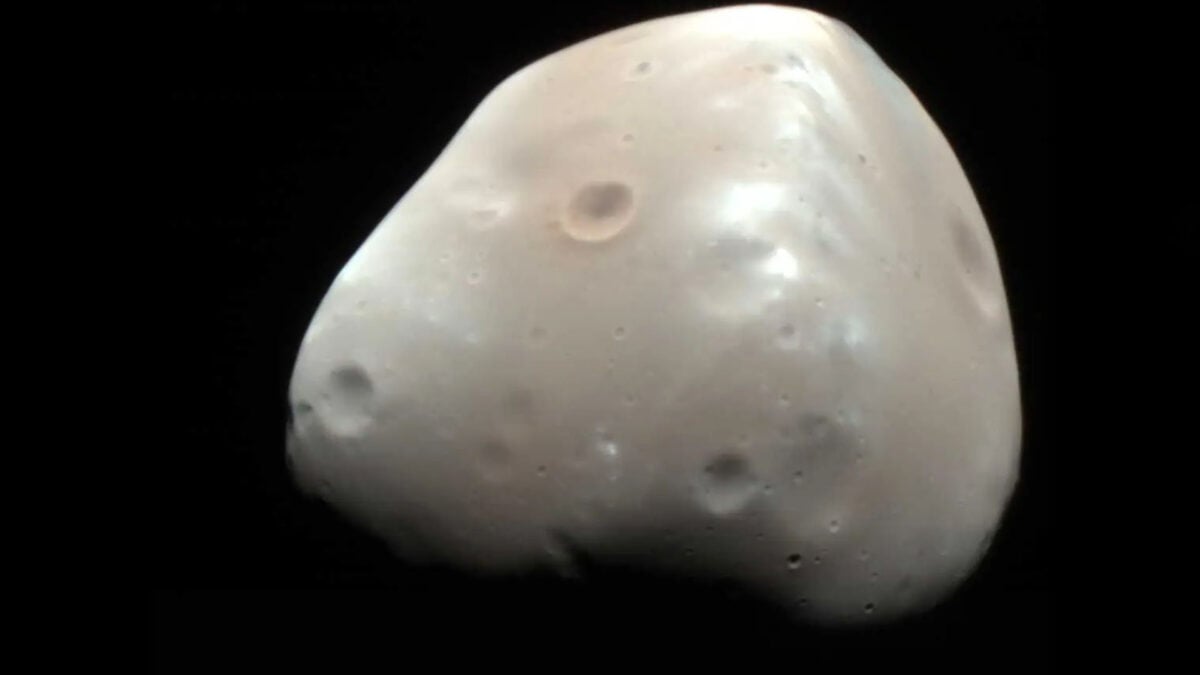
Decades ago, a NASA spacecraft swooped past Mars’ smaller moon, Deimos, revealing a smooth, dust-strewn world covered in a thick layer of regolith. Since then, scientists have wondered how the Martian moon got its youthful look compared to its larger counterpart, Phobos. Now, a recent flyby of Deimos may have traced the cause to a violent collision during its early past. Using images gathered by the European Space Agency’s (ESA) Hera mission, a new study suggests that a single asteroid strike may have dramatically reshaped Mars’ outer moon. The findings, published in Nature Astronomy, show how the impact could have tossed large amounts of material across Deimos’ surface, giving it its surprisingly smooth appearance. The results imply that Deimos is a rubble pile, similar to asteroids, that may have formed from material kicked up from Mars by surface impacts, according to the researchers behind the study. Deimos is the smaller of Mars’ two moons, orbiting Mars every 30 hours. Measuring at 9 by 7 by 6.8 miles in size (15 by 12 by 11 kilometers), its tiny body is lumpy and heavily cratered. In 1977, NASA’s Viking 2 orbiter pulled off a historic flyby of Deimos, capturing high-resoluti
Source: For the complete article, please visit the original source link below.