'A dark and violent scene': The 1927 painting that foretold Germany's downfall
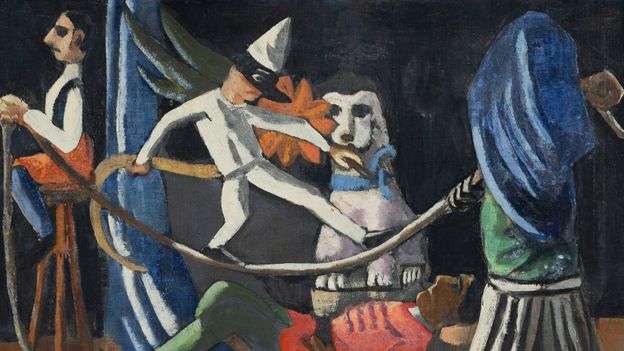
A new exhibition focuses on the paintings of German painter Max Beckmann. Among them is Variety Show, an unsettling artwork depicting a chaotic cabaret scene – what does it mean, and did it foreshadow the rise of Nazism? In the 1927 painting Variety Show by German painter Max Beckmann, a cabaret performance is turned on its head. A man in a red military overcoat lies on the floor. Another walks a slack tightrope over his supine body and nearby a figure stands with their face covered in a blue cloth, while a seemingly uninterested man on a stool faces away from the spectacle. A large dog-like creature watches in the background. "It seems to be a stage, figures performing, but there's this idea of nobody really taking responsibility for what's going on here," art historian Lucy Wasensteiner tells the BBC. At first glance, it's a depiction of the nightlife prevalent in 1920s Germany. Entertainment during the Weimar period (1918–1933) exploded, with cabaret in particular becoming increasingly boundary-pushing, political and satirical. But if you look longer, the mood in the artwork is less celebratory and more peculiar. What does this strange painting tell us about this precarious mome
Source: For the complete article, please visit the original source link below.



