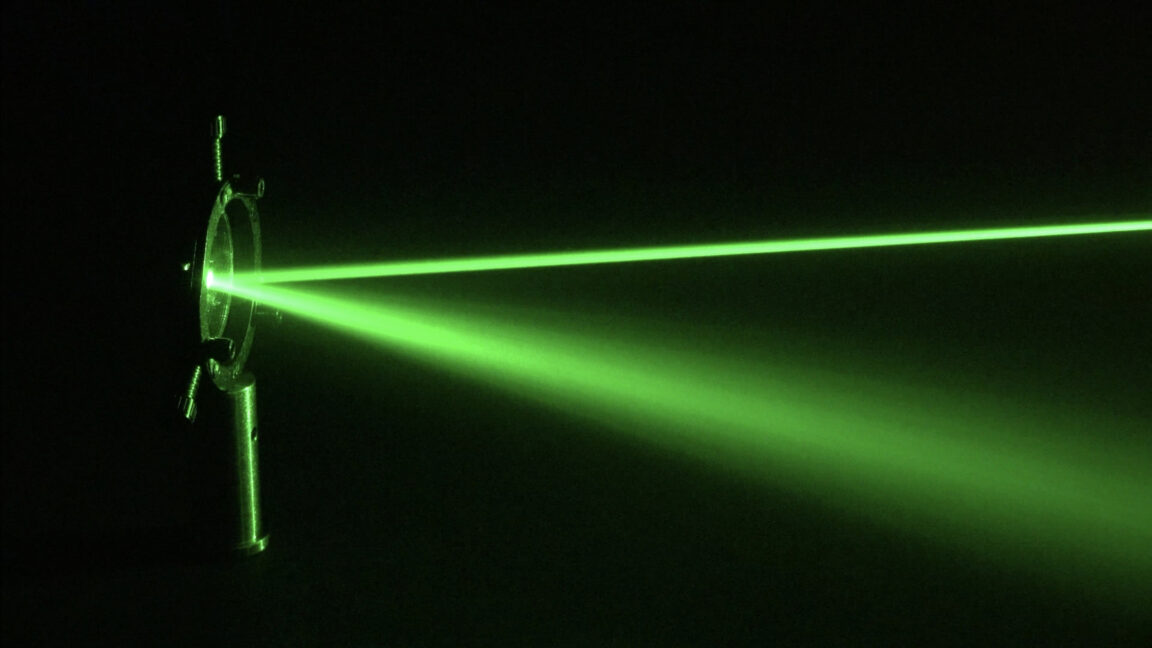
An experimental tour-de-force: Entanglement between glass bead and light
Getting a glass bead to act like a quantum object by entangling it with light.
In an iconic thought experiment, Austrian physicist Erwin Schrödinger imagined a cat that could be dead or alive—a clever analogy to the quirkiness of quantum superpositions. Nearly a century after Schrödinger’s cat, physicists have created a new family of exotic “cat states” in the quantum realm. Quantum superpositions refer to how quantum systems can exist in more than one state at the same time. The act of observation determines the system’s “final” state, so to speak. In a recent Physical Review X paper, physicists report the development of a new way to create and control quantum superpositions in the motion of a trapped ion system. As a result, the team created a variety of states with “distinctive interference patterns, rotational symmetry, and clear signatures of nonclassical behavior,” study lead author Sebastian Saner told Gizmodo. In other words, physicists built an expanded family of quantum superposition based on exotic quantum states. What’s more, the new method gives researchers a greater degree of freedom in working with the quantum world. “Even though physicists have been thinking about quantum superpositions for more than a century, we are still finding new ways to
Jun 16, 2026 → Jun 16, 2026
In an iconic thought experiment, Austrian physicist Erwin Schrödinger imagined a cat that could be dead or alive—a clever analogy to the quirkiness of quantum superpositions. Nearly a century after Schrödinger’s cat, physicists have…
Read original at Gizmodo →1 updates from 1 source.
In an iconic thought experiment, Austrian physicist Erwin Schrödinger imagined a cat that could be dead or alive—a clever analogy to the quirkiness of quantum superpositions. Nearly a century after Schrödinger’s cat,…
Read original at Gizmodo →What this story stands on. Tier 0 is a primary record or the subject's own words; higher tiers must be attributed, never stated as bare fact.
In an iconic thought experiment, Austrian physicist Erwin Schrödinger imagined a cat that could be dead or alive—a clever analogy to the quirkiness of quantum superpositions. Nearly a century after Schrödinger’s cat, physicists have…
View source →Tier key: T0 = Primary source · T1 = Wire · T2 = Outlet report · T3 = Commentary
Getting a glass bead to act like a quantum object by entangling it with light.
Physicists tend to think of light in terms of photons: massless, elementary particles “carrying” the forces of nature. And elementary particles, like the photon, are indivisible.…
Scientists can now sculpt the quantum states of tiny particles to their liking—an odd yet mind-blowing revolution leading to some fascinating inventions. And the latest in the…