← All storiesScienceDeveloping story

Black hole mergers put limits on star-destroying supernovae

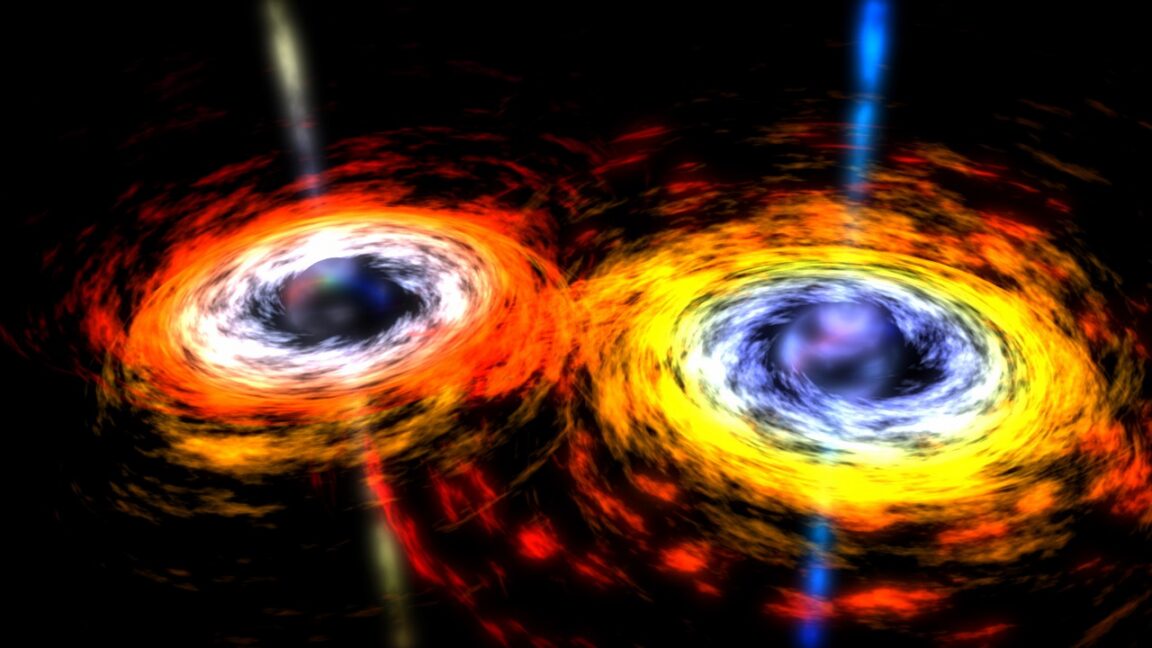
Pair instability supernovae create a “mass gap” in black holes. Many of the early exoplanet discoveries were exciting on their own, confirming that there really were strange new worlds out in the Universe. But over time, our focus has shifted more toward numbers, as we began using the frequency of objects like super-Earths and mini-Neptunes to learn more about how planets form. With four gravitational wave detectors now having generated years of data, we may be on the verge of seeing something similar happen with black hole mergers. On Wednesday, researchers released an analysis suggesting that there’s a “mass gap” in the population of black holes that we’ve detected so far. And that gap supports the idea that some stars are so massive that they die in something called a pair-instability supernova, which is so violent that it leaves nothing but debris behind. Black holes result from the collapse of a star’s core during a supernova. While the outer layers of a star explode outward, the innermost layers plunge inward, funneling a fraction of the star’s mass into the black hole (or neutron star if the star’s mass is too small). We’re not sure what the upper limit on a star’s mass is,
1
updates in timeline
1
distinct sources
1 day
story span
Apr 1, 2026
latest update

Apr 1, 2026 → Apr 1, 2026

KEY PEOPLE, ORGS & TOPICS
LATEST DEVELOPMENT
Apr 1, 2026·Ars TechnicaT2 · Outlet report
Black hole mergers put limits on star-destroying supernovae

Pair instability supernovae create a “mass gap” in black holes. Many of the early exoplanet discoveries were exciting on their own, confirming that there really were strange new worlds out in the Universe. But over time, our focus has…

Read original at Ars Technica →
ACTIVITY · UPDATES PER MONTH
Apr 26

1 updates from 1 source.

Showing 1 of 1 updates

Timeline (1 updates)

April 2026

1 update
Apr 1, 2026·Ars TechnicaT2 · Outlet reportLATEST
Black hole mergers put limits on star-destroying supernovae

Pair instability supernovae create a “mass gap” in black holes. Many of the early exoplanet discoveries were exciting on their own, confirming that there really were strange new worlds out in the Universe. But over…

Read original at Ars Technica →

Sources & evidence (1)

What this story stands on. Tier 0 is a primary record or the subject's own words; higher tiers must be attributed, never stated as bare fact.

T2 · Outlet report× 1
COVERAGE BY SOURCE
Ars Technica 1
STRONGEST EVIDENCE
T2 · Outlet reportArs TechnicaApr 1, 2026

Pair instability supernovae create a “mass gap” in black holes. Many of the early exoplanet discoveries were exciting on their own, confirming that there really were strange new worlds out in the Universe. But over time, our focus has…

View source →

Tier key: T0 = Primary source · T1 = Wire · T2 = Outlet report · T3 = Commentary

Related stories