← All storiesTechnologyDeveloping story

Both Pluto and Titan Share a Mystery Molecule That's Never Been Seen Before

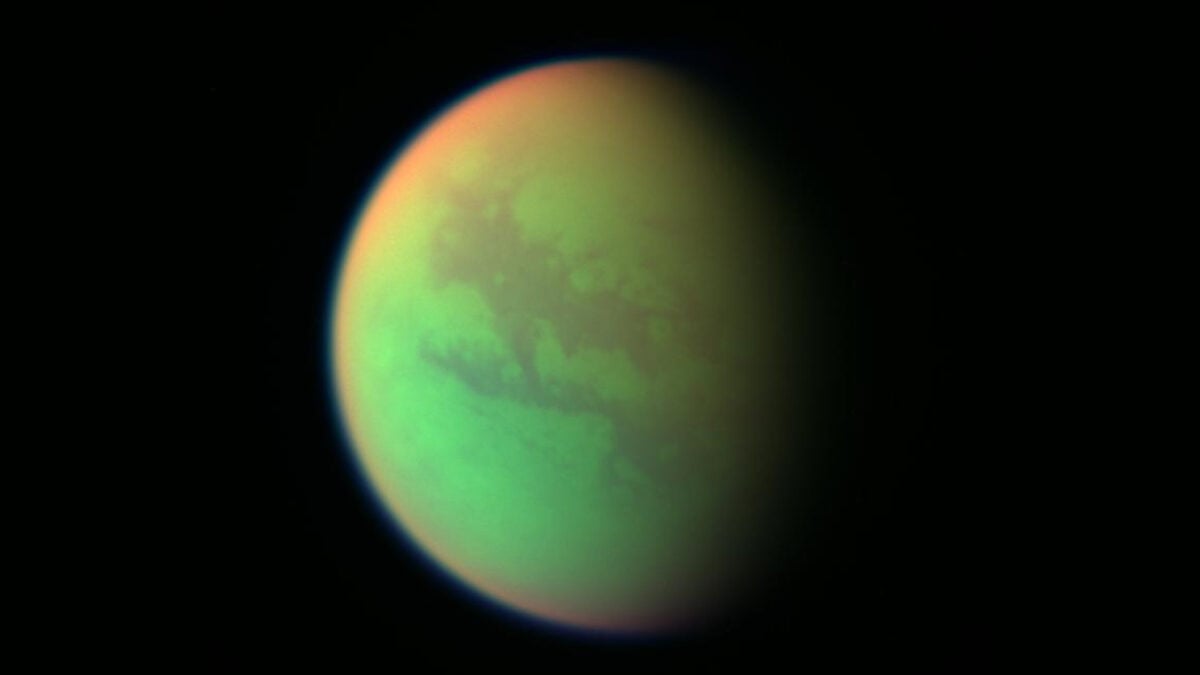
Every element has a unique set of absorption and emission lines that create spectral signatures. These signals are key information for astronomers studying faraway objects—but what happens when there’s no good match for a particular signature? While studying Pluto and Saturn’s largest moon Titan, researchers spotted a missing band of light in their spectral signatures, specifically at the 5.11-micrometer line. However, after searching past datasets and literature, they weren’t able to find any suitable matches for whatever molecule was responsible for this phenomenon. In other words, Pluto’s and Titan’s surfaces may harbor an unknown molecule—a substance that we’ve never seen anywhere else in our solar system and beyond. A paper detailing the results has been accepted for publication in Astronomy & Astrophysics and is currently available as a preprint in arXiv. “We have a few candidates, but it will not be a simple compound,” Bruno Bézard, the study’s first author and a researcher at the Paris Observatory, told New Scientist. “Whatever it is, it will be a surprise.” Pluto and Titan don’t look much alike externally, but both possess nitrogen-rich atmospheres with some methane. Photo
1
updates in timeline
1
distinct sources
1 day
story span
Jul 6, 2026
latest update

Jul 6, 2026 → Jul 6, 2026

LATEST DEVELOPMENT
Jul 6, 2026·GizmodoT2 · Outlet report
Both Pluto and Titan Share a Mystery Molecule That's Never Been Seen Before

Every element has a unique set of absorption and emission lines that create spectral signatures. These signals are key information for astronomers studying faraway objects—but what happens when there’s no good match for a particular…

Read original at Gizmodo →
ACTIVITY · UPDATES PER MONTH
Jul 26

1 updates from 1 source.

Showing 1 of 1 updates

Timeline (1 updates)

July 2026

1 update
Jul 6, 2026·GizmodoT2 · Outlet reportLATEST
Both Pluto and Titan Share a Mystery Molecule That's Never Been Seen Before

Every element has a unique set of absorption and emission lines that create spectral signatures. These signals are key information for astronomers studying faraway objects—but what happens when there’s no good match for…

Read original at Gizmodo →

Sources & evidence (1)

What this story stands on. Tier 0 is a primary record or the subject's own words; higher tiers must be attributed, never stated as bare fact.

T2 · Outlet report× 1
COVERAGE BY SOURCE
Gizmodo 1
STRONGEST EVIDENCE
T2 · Outlet reportGizmodoJul 6, 2026

Every element has a unique set of absorption and emission lines that create spectral signatures. These signals are key information for astronomers studying faraway objects—but what happens when there’s no good match for a particular…

View source →

Tier key: T0 = Primary source · T1 = Wire · T2 = Outlet report · T3 = Commentary

Related stories

ScienceT2 · Outlet report

NASA's New Horizons Spacecraft Just Woke Up From a Long Nap Ahead of Exploring Beyond Pluto - CNET

Our gifting experts are obsessively searching for holiday gifts that are unique, thoughtful and suitable for any budget. Our expert, award-winning staff selects the products we…

3 updates3 sources7 days long
Jul 9, 2026 → Jul 16, 2026
Latest: 11 Years After Historic Flyby, Scientists Discover Giant Landslides on Pluto · Gizmodo
ScienceT2 · Outlet report

‘Bizarre’ planet orbiting dead star may preview fate of our solar system | CNN

New observations may offer fresh clues into how a giant exoplanet survived the violent death of its host star — and came to closely orbit its stellar remnants. The findings…

1 update1 source
Jul 2, 2026
Latest: ‘Bizarre’ planet orbiting dead star may preview fate of our solar system | CNN · CNN
TechnologyT2 · Outlet report

A popular academic journal is coming down hard on AI-generated submissions

We're still in the early stages of the AI revolution, but there's already plenty of evidence that it won't be purely a blessing. Generative AI has made writing exponentially…

2 updates2 sources
May 16, 2026
Latest: Research repository ArXiv will ban authors for a year if they let AI do all the work | TechCrunch · TechCrunch
ScienceT2 · Outlet report

Thin atmosphere detected around distant object beyond Pluto | CNN

Astronomers have detected a thin atmosphere around a tiny celestial body in the outer solar system for the first time — an object previously thought to be too small to support…

1 update1 source
May 4, 2026
Latest: Thin atmosphere detected around distant object beyond Pluto | CNN · CNN