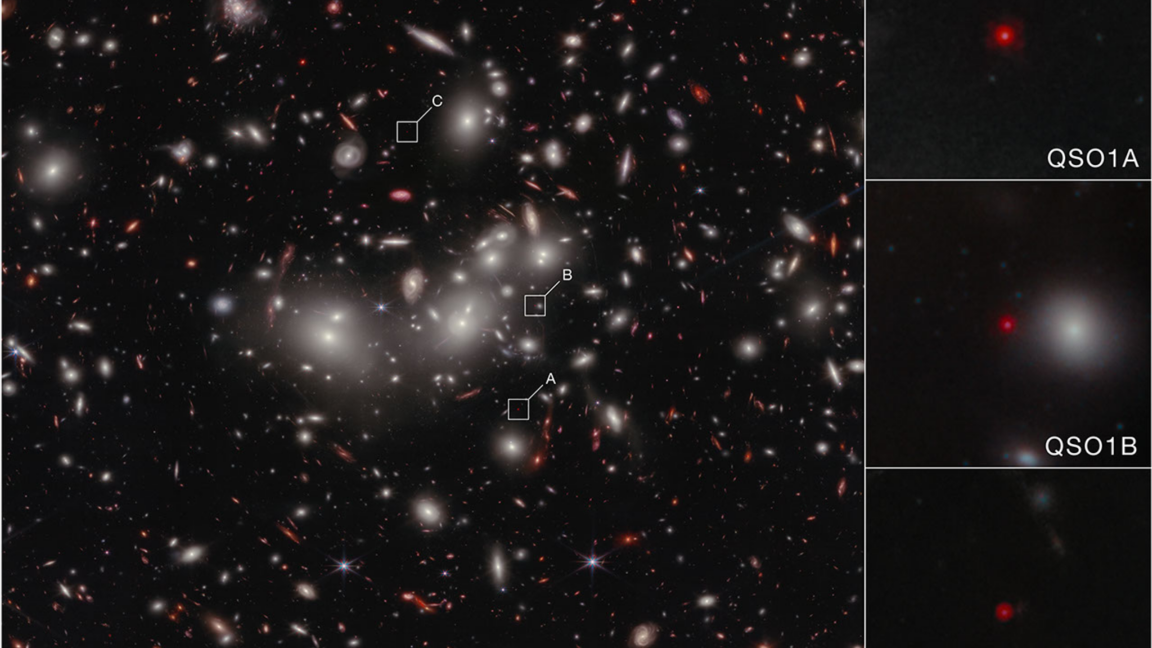
"Little red dot" in early Universe is a naked supermassive black hole
The black hole accounts for over two-thirds the mass of the object it inhabits. The James Webb Space Telescope (JWST) was designed to give us the ability to look at one of the…
Nereid, Neptuneâs third-largest moon, could be the only intact survivor from an ancient set of moons destroyed early in the solar systemâs history, according to a new analysis based on data from the James Webb Space Telescope. Neptune, the eighth and most distant planet from the sun, stands out among the outer planets in our solar system for its odd group of moons. The other outer giants â Uranus, Saturn and Jupiter â all have a broadly similar, orderly set of satellites, with several larger moons orbiting in the same direction as the host planetâs rotation. But Neptune has a far smaller and more chaotic collection of moons: Triton, Neptuneâs largest satellite, dwarfs all the others and orbits in the opposite direction of its hostâs rotation. It is the only large moon in the solar system to do so. Astronomers suspect the reason for Tritonâs odd behavior is that it didnât originate from the remnants of Neptuneâs formation, which would make it orbit in the same direction as that planet. They hypothesize instead that Triton might have originated from the Kuiper Belt, a ring-shaped region of icy bodies at the edge of the solar system, and entered the Neptunian envir

May 20, 2026 → May 20, 2026
Nereid, Neptuneâs third-largest moon, could be the only intact survivor from an ancient set of moons destroyed early in the solar systemâs history, according to a new analysis based on data from the James Webb Space Telescope. Neptune,…
Read original at CNN →1 updates from 1 source.
Nereid, Neptuneâs third-largest moon, could be the only intact survivor from an ancient set of moons destroyed early in the solar systemâs history, according to a new analysis based on data from the James Webb Space…
Read original at CNN →What this story stands on. Tier 0 is a primary record or the subject's own words; higher tiers must be attributed, never stated as bare fact.
Nereid, Neptuneâs third-largest moon, could be the only intact survivor from an ancient set of moons destroyed early in the solar systemâs history, according to a new analysis based on data from the James Webb Space Telescope. Neptune,…
View source →Tier key: T0 = Primary source · T1 = Wire · T2 = Outlet report · T3 = Commentary
The black hole accounts for over two-thirds the mass of the object it inhabits. The James Webb Space Telescope (JWST) was designed to give us the ability to look at one of the…
Astronomers have detected a thin atmosphere around a tiny celestial body in the outer solar system for the first time â an object previously thought to be too small to support…
Precision engineer whose unit at Cranfield University helped develop scanners, tiny integrated circuits and the mirrors of the James Webb space telescope For the past four years,…
Like tiny photobombers, cosmic anomalies resembling small, bright red points show up in almost every snapshot taken by the most powerful space telescope ever made. Astronomers now…