← All storiesScienceDeveloping story

"Little red dot" in early Universe is a naked supermassive black hole

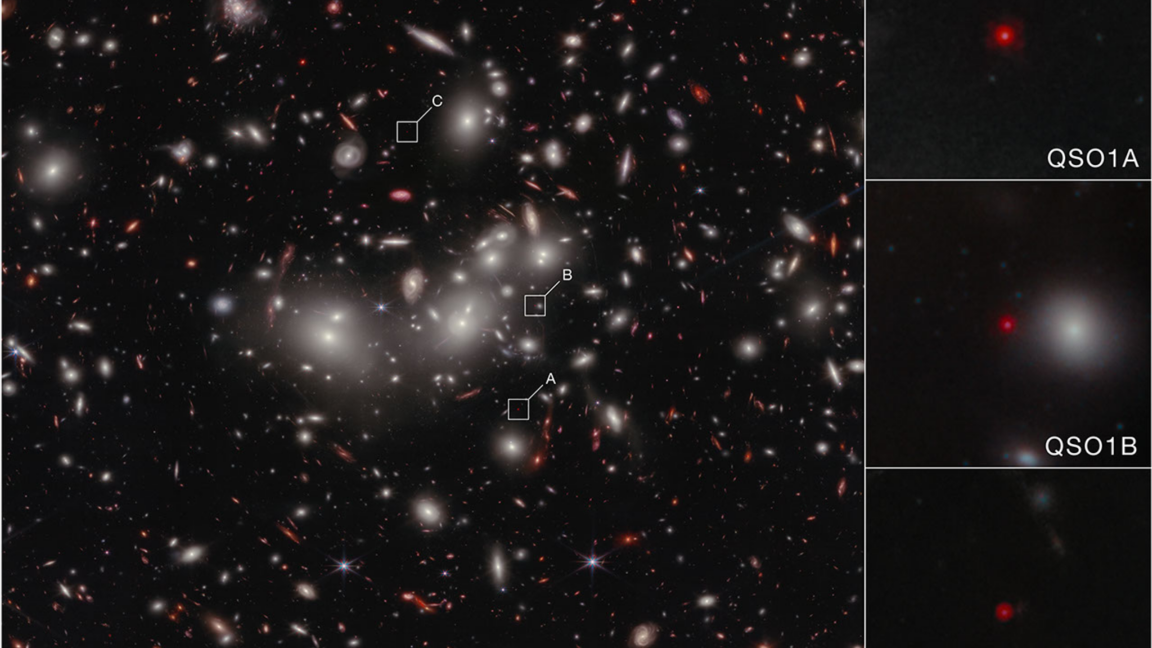
The black hole accounts for over two-thirds the mass of the object it inhabits. The James Webb Space Telescope (JWST) was designed to give us the ability to look at one of the earliest periods in the evolution of the Universe, a time when some of the earliest stars were putting out enough light to ionize the hydrogen that accounted for almost all of the normal matter present at the time. There were lots of ideas about what we might see, but the Universe is full of surprises. One of the first surprises was the existence of what picked up the moniker “little red dots,” which are exactly what their name suggests. After some initial arguments, it became clear that these were early versions of the supermassive black holes that presently sit at the center of almost every galaxy. Now, gravitational lensing has allowed astronomers to confirm that a little red dot is little more than a supermassive black hole without much in the way of a galaxy around it. The little red dot in question is called Abell 2744−QSO1, and gravitational lensing has both magnified it and caused it to appear three times in the vicinity of the galaxy cluster that did the lensing. Based on details in its spectrum, we’
1
updates in timeline
1
distinct sources
1 day
story span
May 27, 2026
latest update

May 27, 2026 → May 27, 2026

LATEST DEVELOPMENT
May 27, 2026·Ars TechnicaT2 · Outlet report
"Little red dot" in early Universe is a naked supermassive black hole

The black hole accounts for over two-thirds the mass of the object it inhabits. The James Webb Space Telescope (JWST) was designed to give us the ability to look at one of the earliest periods in the evolution of the Universe, a time when…

Read original at Ars Technica →
ACTIVITY · UPDATES PER MONTH
May 26

1 updates from 1 source.

Showing 1 of 1 updates

Timeline (1 updates)

May 2026

1 update
May 27, 2026·Ars TechnicaT2 · Outlet reportLATEST
"Little red dot" in early Universe is a naked supermassive black hole

The black hole accounts for over two-thirds the mass of the object it inhabits. The James Webb Space Telescope (JWST) was designed to give us the ability to look at one of the earliest periods in the evolution of the…

Read original at Ars Technica →

Sources & evidence (1)

What this story stands on. Tier 0 is a primary record or the subject's own words; higher tiers must be attributed, never stated as bare fact.

T2 · Outlet report× 1
COVERAGE BY SOURCE
Ars Technica 1
STRONGEST EVIDENCE
T2 · Outlet reportArs TechnicaMay 27, 2026

The black hole accounts for over two-thirds the mass of the object it inhabits. The James Webb Space Telescope (JWST) was designed to give us the ability to look at one of the earliest periods in the evolution of the Universe, a time when…

View source →

Tier key: T0 = Primary source · T1 = Wire · T2 = Outlet report · T3 = Commentary

Related stories

ScienceT2 · Outlet report

The Milky Way ate another galaxy. Scientists say they’ve found the scraps | CNN

An unusual collection of stars may represent the remnants of a dwarf galaxy that the Milky Way devoured about 10 billion years ago. Astronomers have dubbed the ancient galaxy…

2 updates2 sources6 days long
May 23, 2026 → May 29, 2026
Latest: A Single Asteroid Strike May Have Delivered All of Mercury's Water, Study Finds · Gizmodo
GeneralT2 · Outlet report

Chile's Atacama Desert is one of the darkest places on Earth. But now the light is intruding

This remote desert in South America is one of the best places in the world for astronomy, but the slow encroachment of artificial light threatens that. It is a sign of just how…

1 update1 source
May 29, 2026
Latest: Chile's Atacama Desert is one of the darkest places on Earth. But now the light is intruding · BBC
TechnologyT2 · Outlet report

Moon phase today explained: What the Moon will look like on May 8, 2026

It's the day before the Third Quarter, so the Moon is closer to 50% illuminated. During this phase of the lunar cycle, the Moon is only half lit again, but this time it’s the…

7 updates2 sources3 weeks long
May 8, 2026 → May 28, 2026
Latest: Moon phase today explained: What the Moon will look like on May 28, 2026 · Mashable
ScienceT2 · Outlet report

Astronomers believe Neptunian moon is lone intact survivor of ancient collision | CNN

Nereid, Neptune’s third-largest moon, could be the only intact survivor from an ancient set of moons destroyed early in the solar system’s history, according to a new analysis…

1 update1 source
May 20, 2026
Latest: Astronomers believe Neptunian moon is lone intact survivor of ancient collision | CNN · CNN
ScienceT2 · Outlet report

Thin atmosphere detected around distant object beyond Pluto | CNN

Astronomers have detected a thin atmosphere around a tiny celestial body in the outer solar system for the first time — an object previously thought to be too small to support…

1 update1 source
May 4, 2026
Latest: Thin atmosphere detected around distant object beyond Pluto | CNN · CNN
ScienceT2 · Outlet report

Scientists discover 27 potential new planets that orbit two stars in solar systems far, far away

On ‘Star Wars day’, researchers more than double the number of potential known ‘circumbinary’ planets like the fictional Tatooine, home to Luke Skywalker Astronomers have…

1 update1 source
May 4, 2026
Latest: Scientists discover 27 potential new planets that orbit two stars in solar systems far, far away · The Guardian