Webb telescope gets unprecedented look at dead star's surviving planet
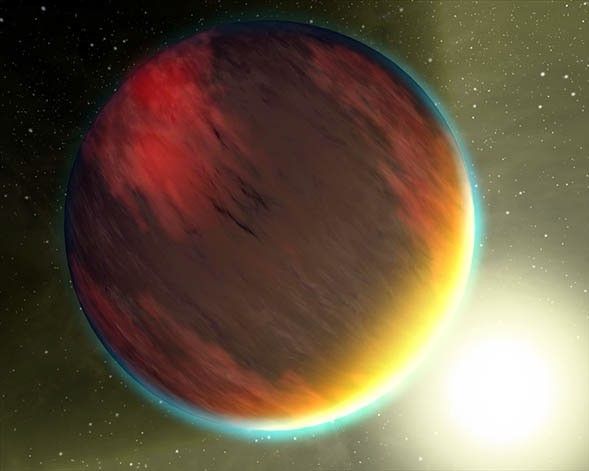
A giant planet somehow heated back up billions of years after its star died, giving astronomers insight into the wildly unexpected afterlife of solar systems. Using NASA's James…
If the large, rocky planet is losing helium, then we can infer what is left behind. Most of the gas in the Universe is a mixture of hydrogen and helium. It’s thought that the initial atmospheres of most planets also start out that way. However, over billions of years, as planets evolve, the composition of their atmospheres may shift. Hydrogen can react with other chemicals, and both it and helium can be lost to space. Venus, Earth, and Mars are thought to have second atmospheres, with their original hydrogen/helium envelopes having been lost and/or transformed. The dynamics of loss are complicated. Lighter elements are lost more easily, but hydrogen can be protected by being incorporated into molecules like methane and ammonia. The gravity of the body can help retain some molecules, and a magnetic field can limit radiation’s ability to blast material out of the atmosphere. Proximity to a star will matter too, both because of the radiation it produces and because it can heat the atmosphere and expand it to where gravity’s influence is less substantial. Given all these complications, it can be difficult to know what to expect to find on exoplanets. But a study in Wednesday’s issue of
Jul 16, 2026 → Jul 16, 2026
If the large, rocky planet is losing helium, then we can infer what is left behind. Most of the gas in the Universe is a mixture of hydrogen and helium. It’s thought that the initial atmospheres of most planets also start out that way.…
Read original at Ars Technica →1 updates from 1 source.
If the large, rocky planet is losing helium, then we can infer what is left behind. Most of the gas in the Universe is a mixture of hydrogen and helium. It’s thought that the initial atmospheres of most planets also…
Read original at Ars Technica →What this story stands on. Tier 0 is a primary record or the subject's own words; higher tiers must be attributed, never stated as bare fact.
If the large, rocky planet is losing helium, then we can infer what is left behind. Most of the gas in the Universe is a mixture of hydrogen and helium. It’s thought that the initial atmospheres of most planets also start out that way.…
View source →Tier key: T0 = Primary source · T1 = Wire · T2 = Outlet report · T3 = Commentary
A giant planet somehow heated back up billions of years after its star died, giving astronomers insight into the wildly unexpected afterlife of solar systems. Using NASA's James…
Our gifting experts are obsessively searching for holiday gifts that are unique, thoughtful and suitable for any budget. Our expert, award-winning staff selects the products we…
Astronomers charted a star’s path over 20 years as it circled an invisible object that was rather hefty. The mysterious object was found to be a stellar-mass black hole, one of…
Within just three days of each other, Chinese and Japanese spacecraft got up close and personal with two different asteroids. The China National Space Administration sent…
Last day to exhibit your breakthrough to 10,000+ tech leaders at Disrupt is on Oct 2. Book Exhibit Table Now. Disrupt doors open Oct. 13. Get your pass and bring someone with you…
NASA on Tuesday revealed the four astronauts who will join the next Artemis mission â a key, two-week flight that will aim to test out various technologies considered vital to…